
Planning to take the TOEFL in 2026? The TOEFL exam pattern changed significantly on January 21, 2026. It is now shorter, adaptive, and uses a brand-new scoring system. The 2026 TOEFL exam pattern has 4 sections – Reading, Listening, Writing, and Speaking – and takes about 90 minutes total. This complete guide explains every section, all 12 task types in the new TOEFL format, the 1-6 scoring scale, and a daily prep strategy that fits into 10 minutes a day.
What is the TOEFL exam pattern in 2026? The TOEFL iBT 2026 has 4 sections: Reading (~30 min, adaptive), Listening (~29 min, adaptive), Writing (~23 min, linear), and Speaking (~8 min, linear). Total test time is about 90 minutes – down from 2 hours. All sections use a new 1-6 band scoring scale aligned with CEFR. There are 12 task types in total, 9 of which are completely new. The updated format took effect January 21, 2026. (Official ETS source)
TOEFL Exam Pattern 2026: What Changed and Why It Matters
ETS updated the TOEFL iBT on January 21, 2026. This is the biggest structural change to the TOEFL test format in years. If you studied for TOEFL before 2026, the exam structure, task types, and scoring system you prepared for no longer exist in the same form. (Learn more on the official ETS website)
Here is a complete before-and-after comparison of the old and new TOEFL exam pattern:
| Feature | Old TOEFL (before Jan 2026) | New TOEFL 2026 |
|---|---|---|
| Total test time | ~2 hours | ~90 minutes |
| Scoring scale | 0–120 (30 per section) | 1–6 band (0.5 increments) |
| Reading format | Fixed difficulty, long passages | Adaptive, 3 task types |
| Listening format | Fixed difficulty, academic lectures only | Adaptive, 4 task types |
| Speaking tasks | 4 integrated tasks, prep time given | 2 tasks, spontaneous responses only |
| Writing tasks | Integrated essay + Academic Discussion | Build a Sentence + Write an Email + Academic Discussion |
| Adaptive testing | No | Yes – Reading and Listening only |
| Score delivery | 4–8 days | Within 72 hours |
Reading Section – ~30 Minutes (Adaptive)
The Reading section in the 2026 TOEFL exam pattern uses multistage adaptive testing. Your second set of questions becomes harder or easier based on how you answer the first set. You respond to around 35–48 questions in total across 3 task types:
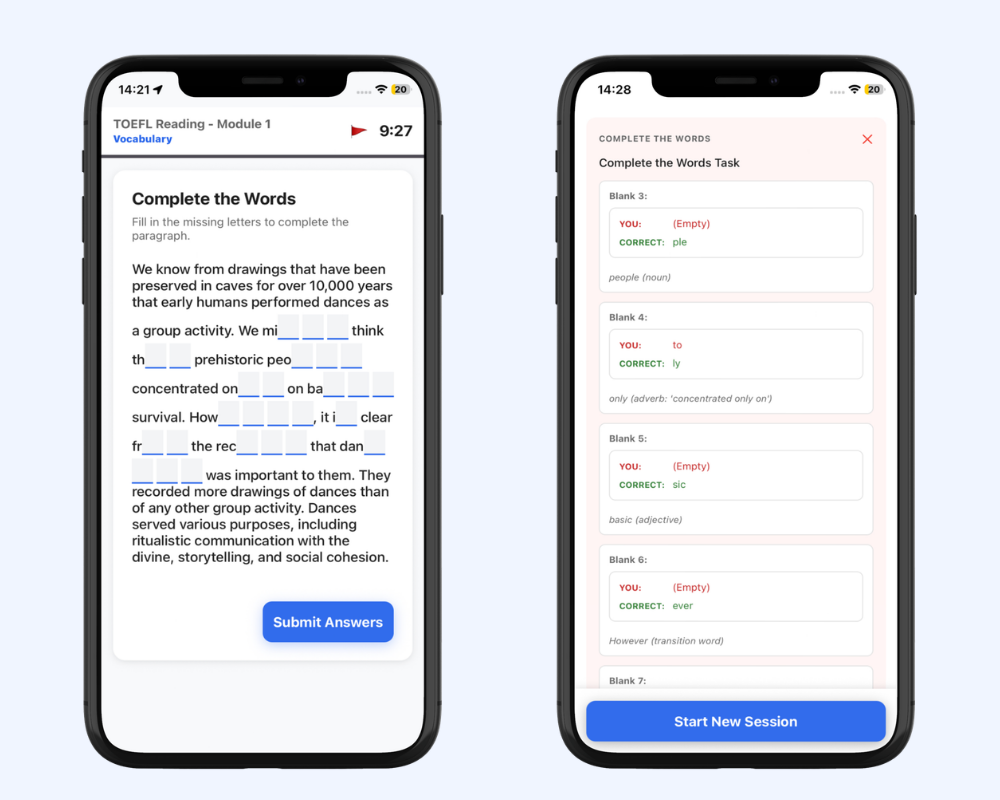
1. Complete the Words New
Fill in missing letters using context clues from the surrounding text. Tests vocabulary accuracy and word recognition under time pressure.
Time tip: Each question is short – move quickly and trust your first instinct.
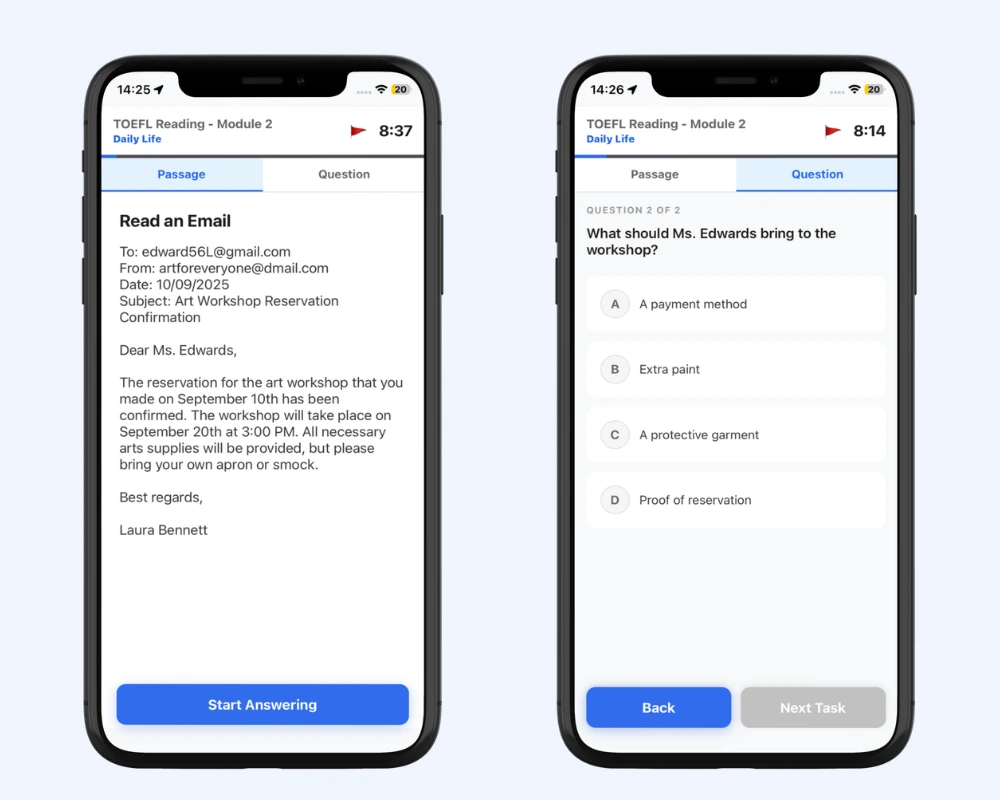
2. Read in Daily Life New
Read realistic everyday texts like emails, notices, and schedules. Tests your ability to understand practical English in context – a key part of the new 2026 TOEFL format.
Strategy: Skim the question first, then scan the text for the answer.
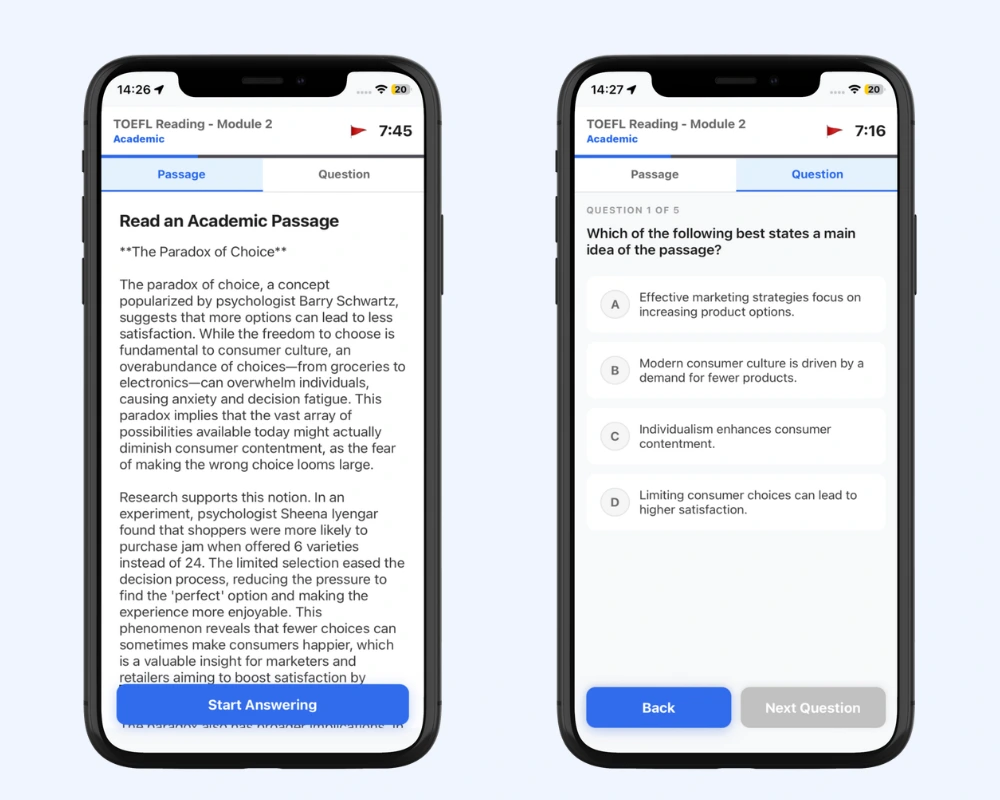
3. Read an Academic Passage Retained
Read shorter academic texts and answer inference, detail, and main idea questions. The passages are shorter than the old TOEFL format but the question depth is similar.
Note: This task type appears in Stage 2 and strongly influences your final band score.
Practice all three reading task types with our TOEFL Reading practice test – updated for the 2026 exam pattern with 10-minute daily sessions and instant scoring on the 1-6 scale.
Listening Section – ~29 Minutes (Adaptive)
Like Reading, the Listening section in the 2026 TOEFL format is multistage adaptive. Your Stage 1 performance routes you to a harder or easier Stage 2 set of questions. There are 4 task types in the 2026 Listening section – 3 of which are brand new:
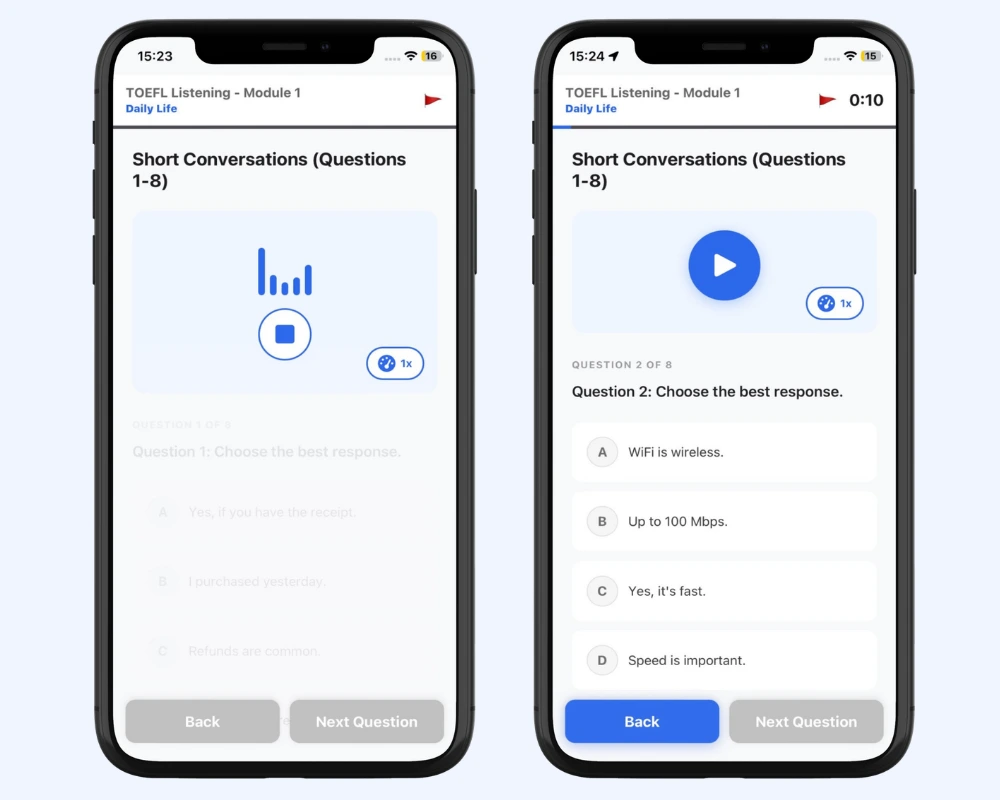
1. Listen and Choose a Response New
Hear a single spoken sentence and choose the most natural reply from three options. Tests your understanding of conversational tone, register, and context.
Tip: Focus on the speaker’s intent – not just the words.
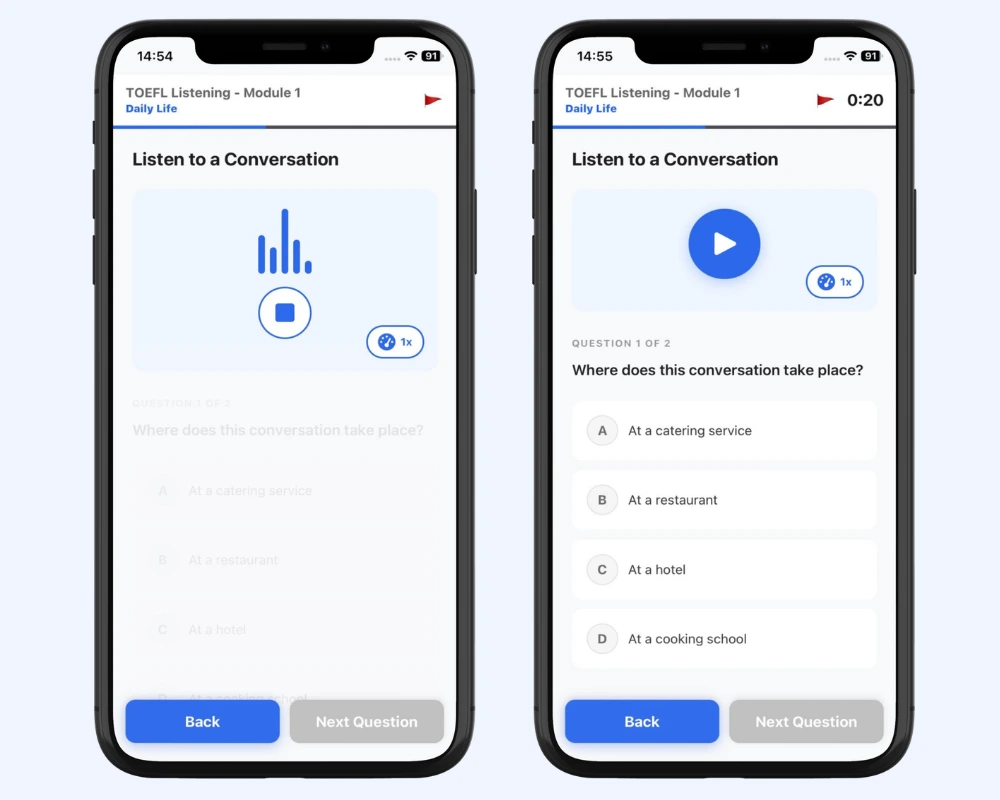
2. Listen to a Conversation New
Listen to a short everyday conversation between two people and answer comprehension questions. Tests your ability to track who said what and understand implied meaning.
Tip: Note the relationship between speakers – it often determines the correct answer.
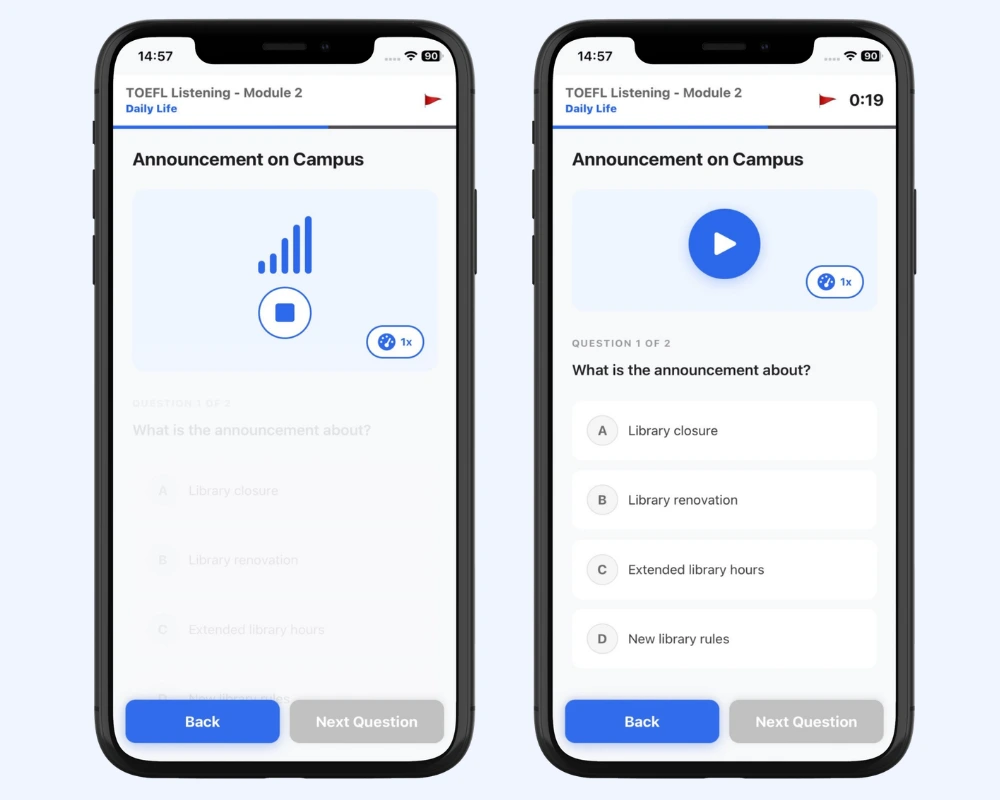
3. Listen to an Announcement New
Listen to a short public or institutional announcement and identify key details, main purpose, and implied information.
Tip: The first and last sentences usually contain the most testable information.
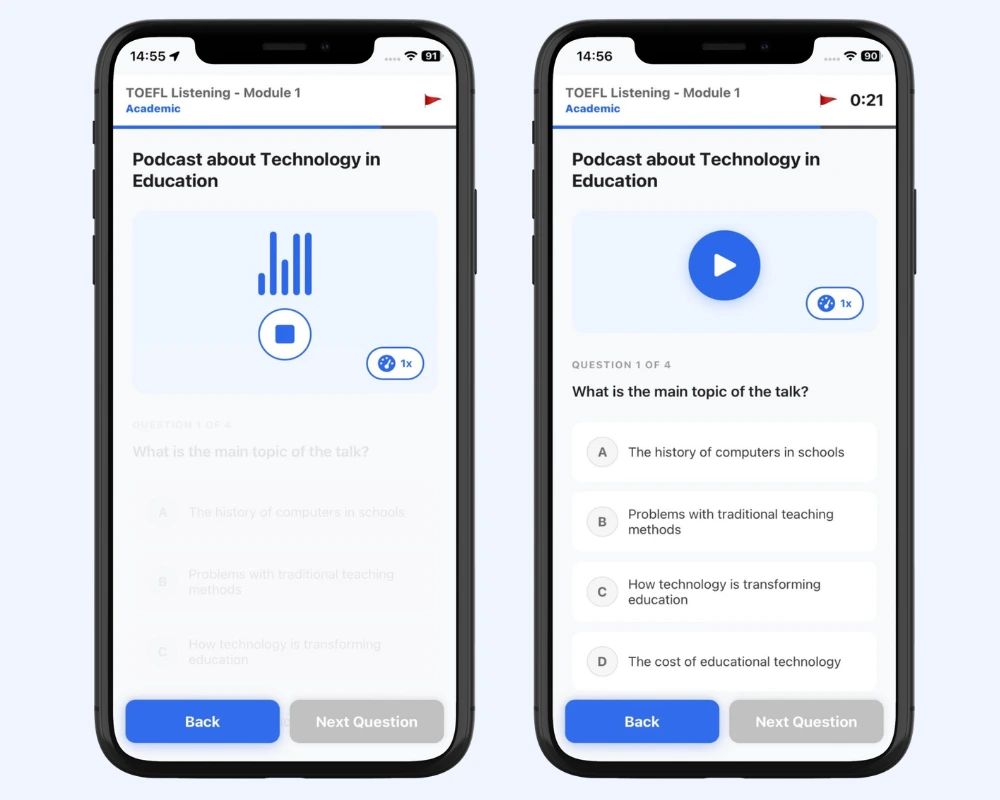
4. Listen to an Academic Talk Retained
Listen to a short academic lecture and answer questions about main ideas, supporting details, and organisation. Shorter than the old format, but still the highest-difficulty task type in Listening.
Tip: This task appears in Stage 2 – performing well here determines your maximum band score.
Build your listening skills with our TOEFL Listening practice tests – all four 2026 task types, with immediate feedback after every question.
Writing Section – ~23 Minutes (Linear)
The Writing section in the 2026 TOEFL exam pattern is not adaptive – every test-taker receives the same tasks in the same order. But it changed more than any other section. The old 300-word argumentative essay is gone. There are now 3 shorter, practical writing tasks that test different real-world writing skills:
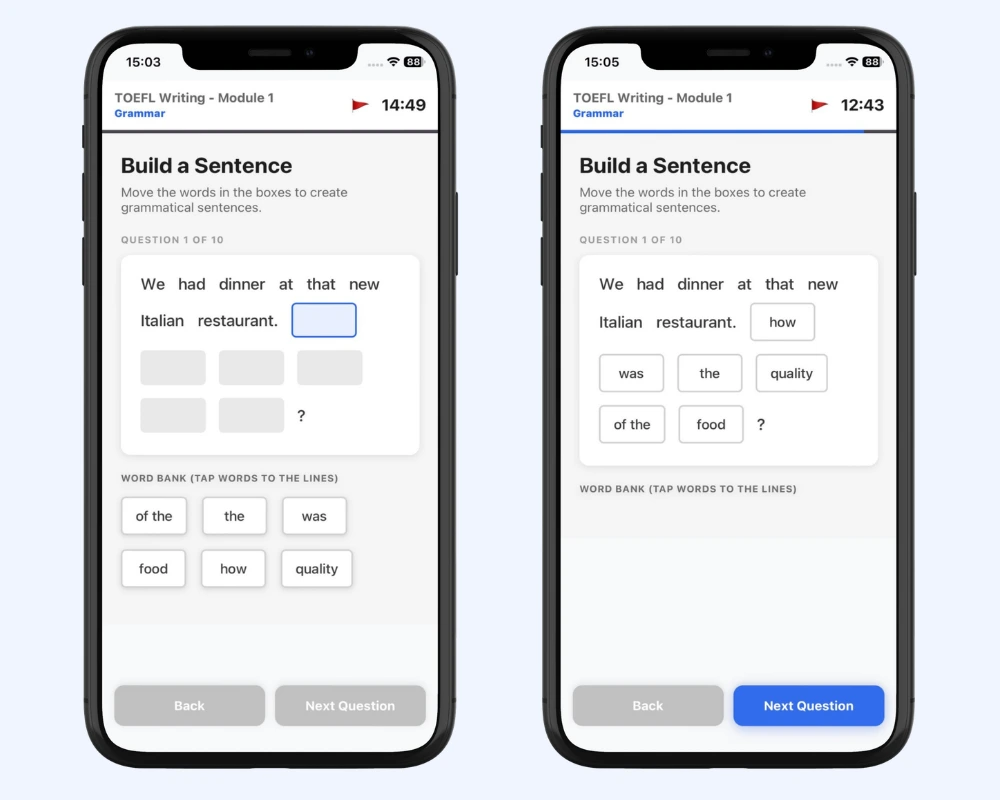
1. Build a Sentence New
Arrange a set of scrambled words into a grammatically correct sentence. Tests grammar accuracy and understanding of sentence structure. There are multiple sentences to complete in the time given.
Strategy: Start with the verb – it anchors the sentence structure.
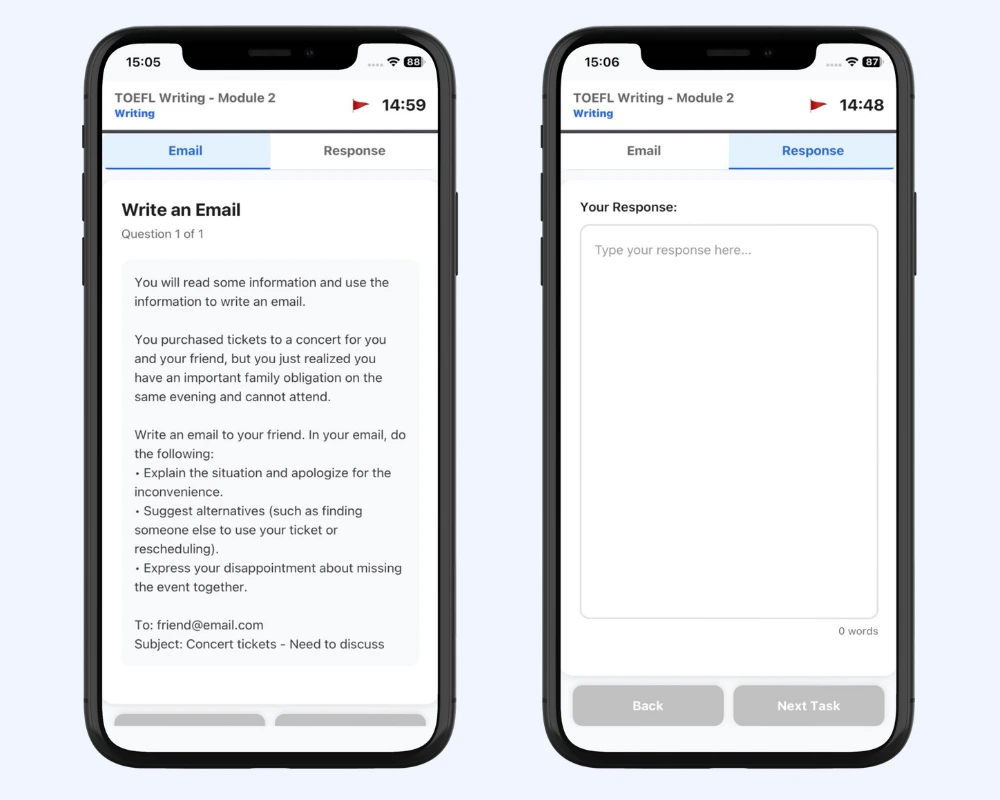
2. Write an Email New
Write a short professional or semi-formal email responding to a given scenario. Tests clarity, tone, appropriate register, and practical communication skills – all new requirements in the 2026 TOEFL format.
Strategy: Use a clear structure: greeting → purpose → detail → close. Avoid informal language.
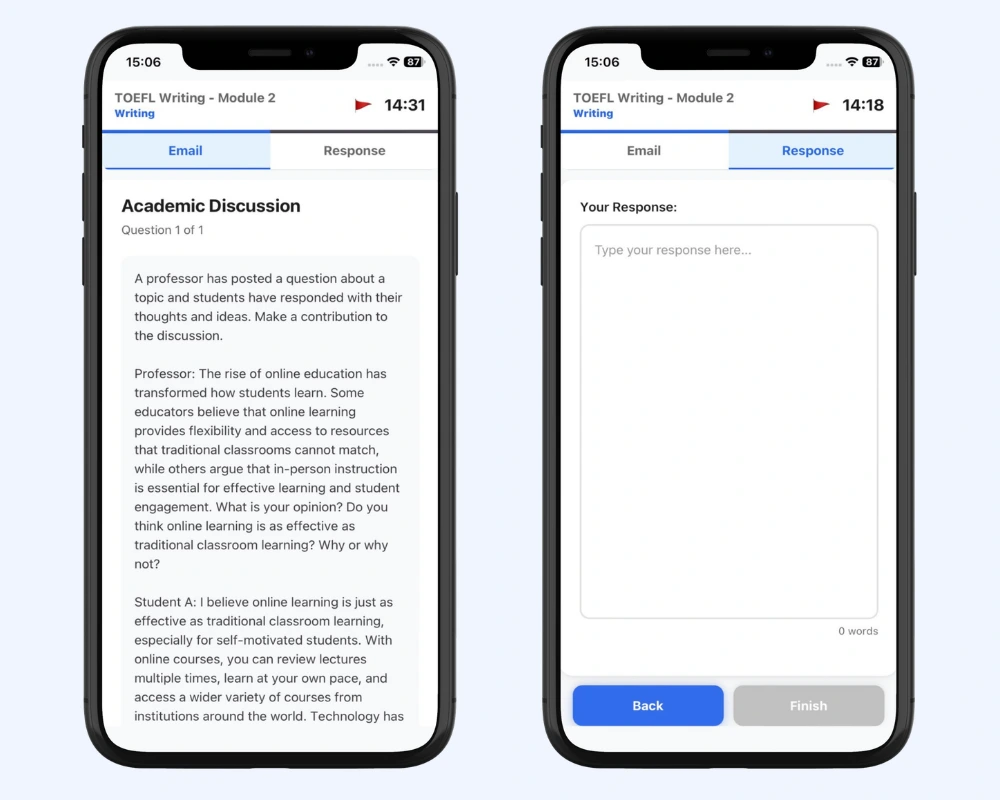
3. Academic Discussion Retained
Read a professor’s question and two student responses, then write your own opinion that adds something new to the discussion. Tests argumentation, cohesion, and academic vocabulary.
Strategy: Do not just agree with an existing post – add a specific, well-supported point.
Speaking Section – ~8 Minutes (Linear)
The Speaking section in the 2026 TOEFL test structure is now much shorter – reduced from about 17 minutes to just 8 minutes. There are 2 task types, both requiring completely spontaneous responses. There is no preparation time for either task – a major change from the old format.
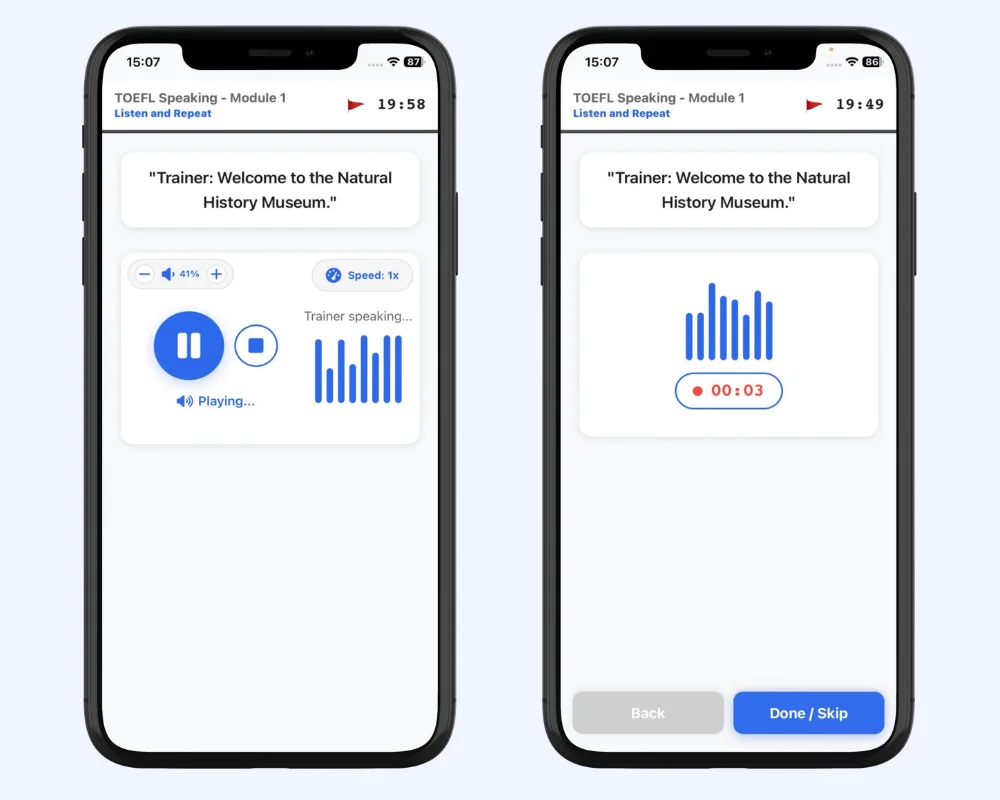
1. Listen and Repeat New
Hear a sentence spoken aloud and repeat it back as clearly as possible. Tests pronunciation accuracy, intonation, and fluency. AI scores your response immediately.
Strategy: Speak at a natural pace – rushing causes pronunciation errors that lower your score.
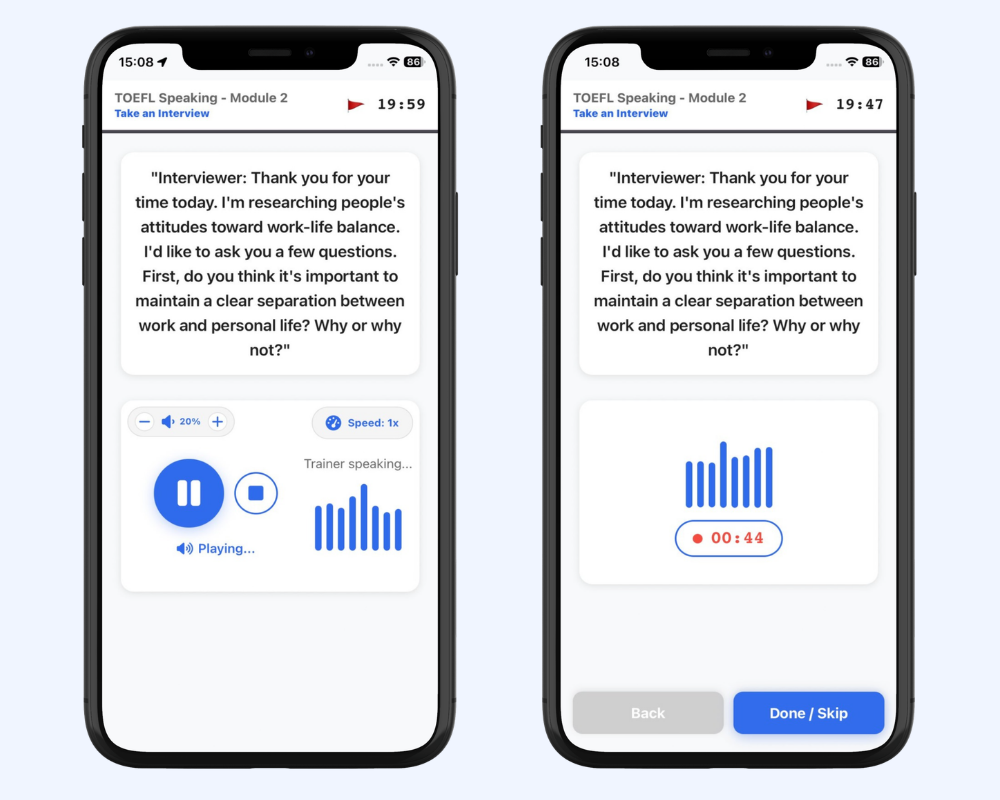
2. Take an Interview New
Answer a series of short questions from an interviewer without any preparation time. Tests speaking confidence, spontaneity, and clarity. This task type is unique to the 2026 TOEFL exam pattern.
Strategy: Answer immediately – even a brief hesitation affects your fluency score. Practice daily with no prep time.
How Adaptive Testing Works in the 2026 TOEFL Format
Reading and Listening in the 2026 TOEFL exam pattern both use a system called multistage adaptive testing (MST). Writing and Speaking are not adaptive – every test-taker receives identical tasks in those sections. Here is exactly how the adaptive system works:
- Stage 1 – same for everyone: All test-takers start with the same difficulty level in both Reading and Listening.
- Stage 2 – adaptive routing: Your Stage 1 accuracy determines which track you enter. Answer well → harder Stage 2 questions. Struggle → easier Stage 2 questions.
- Harder path = higher ceiling: Strong performance in the harder Stage 2 gives access to higher band scores (5.5–6.0).
- Easier path = lower ceiling: Even a perfect score on the easier Stage 2 caps you below 5.0, regardless of performance.
- Writing and Speaking are NOT adaptive: Everyone receives exactly the same tasks in those two sections.
The single most important rule for the 2026 TOEFL test structure: do not sacrifice accuracy for speed in Stage 1. Your Stage 1 accuracy determines your maximum possible band score. Rushing Stage 1 is the most common and most costly mistake on this test.
New TOEFL 1-6 Scoring Scale (2026) Explained
Since January 2026, the TOEFL uses a 1-6 band scale aligned with the CEFR international language framework. This replaced the old 0–120 scoring system. Each of the four sections receives a score from 1.0 to 6.0 in 0.5 increments. Your overall TOEFL score is the average of all four section scores, rounded to the nearest 0.5.
Score calculation example: Reading 5.0 + Listening 5.5 + Speaking 4.5 + Writing 5.0 = 20.0 ÷ 4 = Overall band 5.0
| Band Score | Level | What It Means | Approx. Old Score (0–120) |
|---|---|---|---|
| 6.0 | Expert | Near-native English fluency | 114–120 |
| 5.5 | Very Good | Ready for most top graduate programs | 100–113 |
| 5.0 | Good | Meets requirements for many master’s programs | 88–99 |
| 4.5 | Competent | Meets minimums for some programs | 72–87 |
| 4.0 | Modest | May need conditional admission | 58–71 |
| Below 4.0 | Limited | More preparation recommended | Below 58 |
During the 2026–2028 transition period, TOEFL score reports will show both the new 1-6 band score and a comparable 0–120 score. This helps universities that have not yet updated their minimum requirements to still process applications accurately.
Want to know what band score your target university requires? See our full guide: What is a good TOEFL score in 2026?
How to Prepare for the 2026 TOEFL Exam Pattern in 10 Minutes a Day
The 90-minute 2026 TOEFL test structure is well-suited to daily micro-practice. You do not need long study sessions to improve your band score. You need consistent, focused practice with immediate feedback. Here is a simple weekly schedule based on the 2026 TOEFL exam pattern:
| Day | Section Focus | What to Practise (10 minutes) |
|---|---|---|
| Monday | Reading | Complete the Words + Read in Daily Life tasks |
| Tuesday | Listening | Listen and Choose a Response + Conversations |
| Wednesday | Speaking | Listen and Repeat + Take an Interview (no prep time) |
| Thursday | Writing | Build a Sentence + Write an Email task |
| Friday | Mixed | One question from each section – simulate test pace |
| Weekend | Weak area review | Repeat your lowest-scoring task type from the week |
The TOEFL Mini Practice app is built exactly for this schedule. Each session delivers one real 2026-format task, an instant score on the 1-6 scale, and one specific improvement tip. Over 50,000 learners across 25+ countries use it daily. “1 practice. 1 insight. Every time.”
TOEFL 2026 Prep Tips by Country
India
- Speaking is the most challenging section for most Indian test-takers
- Focus: “Take an Interview” – practise daily without prep time
- Target: 5.0–5.5 for MS/MBA programs in USA or Canada
Saudi Arabia
- The “Write an Email” task requires a professional, polite tone
- Target: 5.0+ for government scholarships
- Focus: Write an Email + Academic Discussion tasks daily
Brazil
- “Complete the Words” can be tricky for Portuguese speakers
- Focus: vocabulary building alongside task practice
- Target: 4.5–5.0 for most graduate programs
China
- Speaking spontaneity without prep time is the key challenge
- Focus: daily Listen and Repeat + Take an Interview practice
- Target: 5.0–5.5 for top US and UK universities
USA (re-takers)
- Old integrated Speaking tasks no longer exist in the 2026 format
- Relearn the Speaking section from scratch
- Focus: spontaneous response speed and natural phrasing
All test-takers
- Do not use TOEFL prep books from before 2026 – task types changed
- Stage 1 accuracy in Reading and Listening is critical – do not rush
- 10 minutes of daily practice beats 2-hour weekend cramming
Frequently Asked Questions – TOEFL Exam Pattern 2026
The TOEFL iBT 2026 exam pattern has 4 sections: Reading (~30 min, adaptive), Listening (~29 min, adaptive), Writing (~23 min, linear), and Speaking (~8 min, linear). Total test time is approximately 90 minutes. There are 12 task types in total – 9 of which are new as of January 21, 2026. All sections are scored on a new 1-6 band scale aligned with CEFR.
The TOEFL iBT 2026 takes approximately 90 minutes – down from about 2 hours before the January 2026 update. The section breakdown is: Reading ~30 min, Listening ~29 min, Writing ~23 min, and Speaking ~8 min. This does not include check-in time at the test centre, which adds approximately 30 minutes.
The new task types added to the 2026 TOEFL format are: Complete the Words and Read in Daily Life (Reading); Listen and Choose a Response, Listen to a Conversation, and Listen to an Announcement (Listening); Build a Sentence and Write an Email (Writing); Listen and Repeat and Take an Interview (Speaking). The Academic Discussion task (Writing) and Academic Talk (Listening) were kept from the old format.
Yes – but only the Reading and Listening sections use adaptive testing. Both use multistage adaptive testing (MST), where your Stage 1 performance determines the difficulty of your Stage 2 questions. Writing and Speaking are not adaptive – every test-taker receives exactly the same tasks in those two sections.
The 2026 TOEFL uses a 1-6 band scale (in 0.5 increments) aligned with CEFR. Each section is scored from 1.0 to 6.0 and your overall score is the average of all four sections. During the 2026-2028 transition, score reports also include a comparable 0-120 score for universities still using the old scale. Scores are delivered within 72 hours of the test.
Students applying to top US engineering or science programs should aim for 5.5 on the new 1-6 scale (roughly equivalent to 100+ on the old 0-120 scale). For mid-tier universities, 5.0 is often sufficient. Speaking is typically the most challenging section – daily AI-feedback practice significantly helps improve your score in this section.
Yes. TOEFL scores remain valid for 2 years from the test date, regardless of when you took the test. During the 2026-2028 transition period, new TOEFL score reports include both the 1-6 band and a comparable 0-120 score, so universities can process applications under both scoring systems while they update their requirements.
Saudi students applying for government scholarships typically need a minimum of 5.0 on the new 1-6 scale. The new “Write an Email” task requires a professional and polite tone – this can be challenging if you are used to the old essay format. Focused daily practice on email writing and Academic Discussion tasks helps significantly. Most Saudi students find that consistent 10-minute daily sessions produce faster improvement than occasional long study sessions.
Yes – and the new 90-minute TOEFL format is well-suited to daily micro-practice. Doing one focused task each day with immediate feedback builds consistent progress faster than occasional long study sessions. The TOEFL Mini Practice app covers all 12 new 2026 task types with AI-powered feedback in exactly 10 minutes per session.
Stop using them for task-type practice. Nine of the twelve task types in the 2026 TOEFL format did not exist before January 2026. You can still use pre-2026 materials for general English skill-building (vocabulary, grammar, reading fluency), but all timed task-type practice must use 2026 format materials that include the new Speaking and Writing tasks.
You now know the full TOEFL exam pattern for 2026. The test is shorter, more practical, and better at measuring real-world English. The key step now is to start practising the new 2026 task types – especially the Speaking and Writing tasks that require immediate, spontaneous responses. Download TOEFL Mini Practice, complete one 10-minute session today, and get your first score on the new 1-6 scale.
Master the 2026 TOEFL format – 10 minutes a day.
Join 50,000+ learners using AI-powered micro-practice to prepare for every task type in the new TOEFL format – with instant feedback and real 1-6 scoring after every session.


Trusted by learners in 25+ countries | Speaking practice | Writing practice