
Imagine sitting down for the TOEFL listening section – and realizing mid-test that everything you practiced was for the old format.
That format no longer exists. Thousands of students are preparing for it right now without knowing.
The TOEFL listening section changed completely in January 2026. It is now adaptive, shorter, and uses different question types. If your study materials are from before 2026, they may be preparing you for a test that does not exist anymore.
📖 What’s inside this guide
- ✓ The complete 2026 TOEFL listening format explained simply
- ✓ All 4 new question types with examples and strategies
- ✓ A full practice test you can try right now
- ✓ Complete answer key with explanations
- ✓ 7 proven strategies for the new format
- ✓ The one thing most guides leave out: feedback that tells you exactly what to fix


Trusted by 50,000+ TOEFL learners worldwide
What Changed: The New TOEFL Listening Format (January 2026)
On January 21, 2026, ETS updated the TOEFL iBT. The listening section changed a lot. Here is exactly what you will face on test day.
The Adaptive Module System
The old listening section had a fixed format – 3 lectures and 2 conversations. That is gone.
Now, the listening section has two modules instead of one.
- Module 1 (Routing Module): Same for everyone. Your performance here decides what happens next.
- Module 2 (Adaptive): If you answered about 60% of Module 1 correctly, you get the harder version. Below 60%, you get the easier version.
Important: Getting the easier Module 2 is not a failure. Both paths measure your real level accurately. The test adapts to you – it is not designed to trick you.
Total time for both modules: about 27 minutes. A clock on the screen shows how much time is left.
The Four Question Types (All New)
| Question Type | Length | Questions | Module 1 | Hard Module 2 | Easy Module 2 |
|---|---|---|---|---|---|
| Listen & Choose a Response | 20 – 30 sec | 2 – 3 | ✓ | Limited | ✓ |
| Conversations | 30 – 60 sec | 2 – 3 | ✓ | ✓ | ✓ |
| Announcements | 20 – 30 sec | 2 | ✓ | ✓ | ✓ |
| Academic Talks (Lectures) | ~90 sec | 5 each | ✓ | ✓ | ✗ |
Key insight: Academic talks carry 5 questions each. They only appear in Module 1 and the hard Module 2. Scoring about 60% on Module 1 gives you access to these higher-value questions.
New Scoring (1 – 6 Scale)
- Scores are now on a 1 – 6 band scale (like IELTS), aligned with the CEFR framework
- You also receive an equivalent 0 – 120 score for two years (until 2028) so universities can compare
- You see an unofficial score right after the test. Your official score arrives within 72 hours
How to Master All 4 TOEFL Listening Question Types
The new format has four distinct tasks. Each tests a different skill. Understanding them is half the work – here is what each one requires.
Task 1: Listen and Choose a Response NEW
You hear a short sentence or question. No text appears on screen – audio only. You choose the most natural response from four options.
Why it is hard: This tests whether you understand the intention behind words, not just the words themselves. You need to recognize if someone is asking, complaining, joking, or requesting – and choose the response that fits naturally.
Example:
Speaker: “Didn’t I see you at the library yesterday?”
- A) “Yes, I was studying for my exam.” ← Best answer
- B) “I like books.”
- C) “Libraries are important.”
- D) “I don’t like studying.”
Strategy: Before looking at the options, predict what kind of response sounds natural. Then match your prediction to the choices.
Task 2: Conversations (Everyday Scenarios)
You hear a short conversation (30 – 60 seconds) between two people – often about campus life, schedules, or problems. Then you answer 2 – 3 questions.
What is tested: Main idea, specific details, speaker’s attitude, and inference (what the speaker means but does not say directly).
Note-taking strategy: Divide your scratch paper into two columns – one per speaker. Write 2 – 3 words per person about their main point. Do not try to write everything. You are listening, not transcribing.
Woman: wants to add eng class – worried about time. 12 credits + 15h work/week
Man: suggests waiting – class is hard, lots of lab work
Woman: agrees – doesn’t want to burn out
Task 3: Announcements (Campus Information)
You hear a short announcement (20 – 30 seconds) about a campus event, policy change, or service update. Then 2 questions.
What is tested: Main point, specific details (times, dates, locations), and required actions.
Note-taking strategy: Write down every number, date, or location you hear. These almost always appear in the questions. Ignore everything else – focus only on facts and action steps.
Task 4: Academic Talks (Lectures)
You hear a short academic lecture – about 90 seconds. Then 5 questions. Topics include psychology, sociology, history, economics, biology, art, and more.
This is the highest-value task. Five questions per lecture. It only appears in Module 1 and the hard Module 2.
What is tested: Main idea, lecture organization, specific details, inference (“why did the professor mention this?”), and the professor’s attitude.
Note-taking strategy: Use abbreviations and symbols. An arrow (→) means “causes” or “leads to.” A plus sign (+) means “and also.” Write the main topic in one word. Then write 2 – 3 key ideas with one example each.
Cog load = mental effort used at one time. Brain has limited space (like RAM).
High load = hard to learn. Low load = learning feels easy.
Solution: worked examples + break info into chunks → learn faster, remember longer
Take the Practice Test: Full Listening Section Simulation
Below is a realistic practice test with all 4 question types. Try it like the real test:
- ✓ Read the script as if you are hearing it (on the real test, you only hear audio)
- ✓ Answer each question before reading the answer
- ✓ Try to get 60%+ to feel ready for the hard module
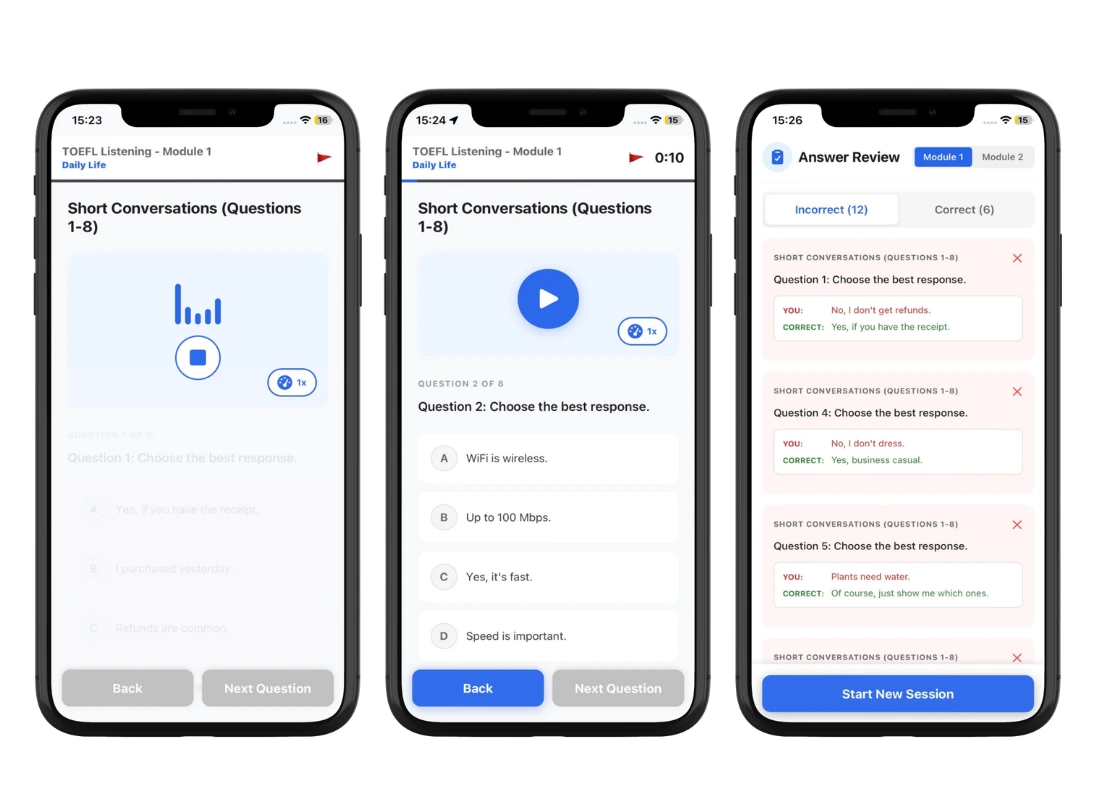
How Listening Practice Looks Inside the App
App screenshot: Listening Practice
Task 1 – Listen and Choose a Response
[On the real test, you only hear the audio. No text is shown.]
[🔊 Audio- two students talking in a hallway]
Student A: “Hey, did you finish the chemistry problem set yet?”
Student B: “Not yet. The last few problems are really confusing.”
What would Student A most likely say next?
- A) “Chemistry is my favorite subject.”
- B) “Yeah, I got stuck on those too. Want to work through them together?”
- C) “You should buy a better chemistry book.”
- D) “I love problem sets.”
B is the only response that naturally continues the conversation. Student A hears a problem (“confusing problems”) and responds with empathy + a helpful offer. Options A, C, and D do not respond to what Student B actually said.
Task 2 – Conversation
[On the real test, you only hear this. Here it is written so you can practice.]
[🔊 Setting: Student talking to a university advisor]
Woman: “I wanted to talk about my course schedule for next semester. I’m thinking about adding another engineering class, but I’m not sure if I have time.”
Man: “Let’s look at what you’re taking this semester first. How many credits are you in right now?”
Woman: “Twelve. Plus I have a part-time job at the library.”
Man: “That’s a full load. How many hours a week at the library?”
Woman: “About 15 hours. I do it mostly on weekends.”
Man: “Okay, so you’re pretty busy. Which engineering class are you thinking of adding?”
Woman: “Advanced Mechanics. It’s only four credits, but I heard it requires a lot of lab work.”
Man: “That’s true. It’s known for being challenging. You might want to wait until next year when your job situation changes.”
Woman: “You’re probably right. I don’t want to burn out.”
Q1: What is the conversation mainly about?
- A) The woman’s job at the library
- B) Whether the woman should add an engineering class
- C) Requirements for Advanced Mechanics
- D) The university’s course limit policy
Q2: How many hours does the woman work at the library each week?
- A) 12 hours
- B) 10 hours
- C) 15 hours
- D) 20 hours
Q3: What will the woman most likely do next semester?
- A) Add the Advanced Mechanics class
- B) Quit her library job
- C) Not take any new classes
- D) Switch to a different major
W: add eng class? 12 credits + library 15h/wk wkends
Advanced Mechanics (4 cr) – much lab work
M: suggests wait – too busy
W: agrees → no burnout
Task 3 – Announcement
[📢 Audio- campus announcement]
“Good afternoon everyone. Starting next Monday, the university library is extending its hours. We will now be open from 8 AM to 10 PM Monday through Thursday, and 8 AM to 6 PM on Friday and Saturday. We remain closed on Sundays.
To celebrate the new hours, the first 100 students who visit next week will receive free printing credits. You will need your student ID at the front desk. We have also upgraded the computers in the research area. Staff are available during all open hours to help you use the new systems. Thank you.”
Q1: What is the main purpose of this announcement?
- A) To promote free printing credits
- B) To inform students about extended library hours
- C) To introduce new computers
- D) To remind students about Sunday closures
Q2: Until what time is the library open on Fridays?
- A) 10 PM
- B) 8 PM
- C) 6 PM
- D) 5 PM
Q3: What do students need to bring to receive free printing credits?
- A) A library card
- B) Their student ID
- C) A printed form
- D) Nothing – it is automatic
Task 4 – Academic Talk (Lecture)
[On the real test, you only hear this as audio. No text appears.]
“Today we’re going to discuss a concept in psychology called ‘cognitive load.’ This is important for understanding how people learn and why some study methods work better than others.
Cognitive load is the amount of mental effort you are using at any moment. Your brain has limited processing capacity – like a computer’s RAM. When you learn something new, you use some of that mental capacity.
Some learning methods use this capacity efficiently. Others waste it. For example, imagine you are learning to drive. At first, everything is hard – steering, pedals, mirrors, traffic. Your brain is completely overloaded. That is high cognitive load. But after months of practice, driving feels automatic. You barely think about it. That is low cognitive load. Your brain has freed up space.
Now here is why this matters for studying. If you try to learn something complex while your cognitive load is already high – maybe you are tired or distracted – you learn worse.
The solution is not to study harder. It is to reduce unnecessary cognitive load. One proven method: worked examples. Instead of giving students a problem to solve alone, you show them a completed problem step by step. This lets them focus on understanding, not figuring out the steps. Another method: break information into smaller chunks. Learn one thing at a time.
The research is clear: students who manage cognitive load learn faster and remember longer.”
Q1: What is this lecture mainly about?
- A) How to become a better driver
- B) Why the brain has limited capacity
- C) How cognitive load affects learning and what to do about it
- D) The difference between easy and hard tasks
Q2: According to the professor, what is cognitive load?
- A) The stress you feel while studying
- B) The amount of mental effort you use at any moment
- C) How fast you can memorize information
- D) The difficulty level of a task
Q3: Why does the professor use the driving example?
- A) To explain why people should practice driving more
- B) To show how cognitive load changes with practice and familiarity
- C) To argue that driving is harder than studying
- D) To compare physical and mental tasks
Q4: How does the professor organize the lecture?
- A) Problem → Historical background → Solution
- B) Definition → Analogy → Real-world application → Solutions → Takeaway
- C) Comparison → Contrast → Summary
- D) Question → Debate → Conclusion
Q5: Based on the lecture, which method helps students learn complex material most effectively?
- A) Attempting hard problems alone from the start
- B) Studying for many hours continuously
- C) Studying worked examples and breaking content into smaller chunks
- D) Reading the textbook without taking notes
How did you do?
You are ready for the hard module. Focus on speed and inference questions to keep improving.
You are in the ideal learning zone. Each question type has specific weak points – the strategies below will help.
That is okay. You just found your weak areas early. That is the whole point of practice. Start with the strategies below – they are built for this.
Here is the Problem with Practice Tests Alone
You now know which answers you got wrong. But do you know why?
Most practice tests tell you: “You got question 5 wrong.”
But they do not tell you: “You missed this because the speaker used ‘thus’ – which signals a conclusion. You focused on the details and missed the structure.”
That specific insight is what actually improves your score. Without it, you repeat the same mistakes in every practice session.
That is the gap TOEFL Mini Practice fills – AI feedback after every session that tells you the why, not just the what.
What Is a Good TOEFL Listening Score?
| Score | Level | What It Means | Typical School Requirement |
|---|---|---|---|
| 6 | Superior | You catch everything, including tone and nuance | Top PhD and medical programs |
| 5.5 | Advanced | Consistent comprehension, very few errors | Law, medical, highly competitive programs |
| 5 | Proficient | Solid comprehension, some missed details | Most STEM, MBA, and graduate programs |
| 4.5 | Intermediate | You understand main ideas, miss some details | Many graduate programs worldwide |
| 4 | Low Proficient | You follow conversations but struggle with lectures | Below most top-university requirements |
| Below 4 | Developing | Significant comprehension gaps | Needs improvement before applying |
Improvement timeline: With consistent daily practice, most students improve about 1 band point in 4 – 6 weeks. Getting from a 4.5 to a 5.5 takes about 8 – 12 weeks. The key word is daily – 10 minutes every day beats 3 hours once a week.
7 Proven Strategies to Improve Your TOEFL Listening Score
Improvement does not come from doing more practice tests. It comes from understanding why you miss questions and fixing that specific thing. Here is how.
1. Identify Your Weak Question Type First
Before anything else, find which question type costs you the most points.
- Struggling with “Listen and Choose”? → Focus on pragmatic meaning and speaker intent
- Missing conversation questions? → Work on inference and catching the main idea
- Losing points on announcements? → Practice noting numbers, dates, and locations fast
- Confused by lectures? → Build note-taking structure and learn to follow the organization
Once you know your weak type, everything else becomes more efficient.
2. Practice Your Weak Type More Than the Others
Generic practice is slow. Targeted practice is fast.
If your weak type is lectures: spend 50 – 70% of your practice time on lectures for the first 2 weeks. Then expand. Your brain learns faster when it is not jumping between different task types constantly.
3. Use the Right Notes for Each Task
Different tasks need different notes:
- Conversations: Two columns – one per speaker. Note their main point, any conflict, and the conclusion.
- Announcements: Numbers, times, dates, and action steps only. Ignore everything else.
- Lectures: Main topic (one word) → 2 – 3 key ideas → one example each → conclusion.
The biggest mistake is trying to transcribe. You are noting reminders, not writing a summary.
4. Build Vocabulary Through Context, Not Lists
Do not memorize vocabulary lists. When you hear an unfamiliar word, pause, listen again, guess the meaning from context, then look it up.
Focus on academic words that appear constantly in lectures: evaluate, strategy, theory, evidence, imply, analyze, summarize. These are the words that matter most on test day.
5. Practice With Multiple Accents
The 2026 TOEFL features British, American, Australian, and Canadian accents. Spend time with podcasts, TED talks, and YouTube videos in all of these. Twenty minutes of daily exposure to real English – not just TOEFL materials – builds your ear fast.
6. Take Module 1 Slowly and Carefully
Your Module 1 score determines everything. If you get the first 2 – 3 questions right, your confidence rises and your performance improves. If you rush and make early mistakes, pressure builds.
Do not rush the opening of Module 1. Breathe. Listen from the first second.
7. Get Specific Feedback After Every Session
This is the single most important strategy.
Knowing you got 22 out of 30 is not useful. Knowing why you missed each one is.
✓ Specific Feedback
- “You missed this because the speaker used ‘thus’ – signaling a conclusion. Focus on transition words.”
- Tells you exactly what to fix
- Improvement compounds session by session
✗ Generic Feedback
- “You got this wrong.”
- Tells you what happened, not why
- You repeat the same mistakes every time
This is the difference between a 4.5 and a 5.5. Not more practice – better feedback.
The Real Problem in Listening Improvement
You can know every strategy on this page. But if you do not get specific feedback on each practice attempt, improvement is slow.
After every listening session, TOEFL Mini Practice App’s Listening Practice shows you:
- ✓ Your score
- ✓ What you missed and why
- ✓ One specific action to improve next session
It is not just practice. It is feedback that actually fixes the problem. In 10 minutes a day.
Research shows 10 minutes of daily focused practice beats occasional 2 – 3 hour sessions. Consistency matters more than duration.
Real Learner Experiences of TOEFL Practice App
“I practised writing for 10 minutes every morning. The AI told me I was not referencing my classmates in the discussion task. Once I fixed that, my score jumped.”
“I practise during my lunch break. I focus on the email task because that was my weakest area. The feedback told me my tone was too casual. I fixed it in one week.”
“I had 10 days before my exam. The app showed me I was writing too slowly. I practised timed writing daily and finished the writing section comfortably on test day.”
Frequently Asked Questions About TOEFL Listening
Is this practice test realistic? Does it match the 2026 format?
Yes. It follows the official 2026 ETS format – all 4 question types, similar difficulty, and the same logic used in the real test.
One difference: on the real test, you only hear audio. No text appears on screen. This article includes transcripts so you can read and practice the skills. To practice with real audio, you can use the app – it includes full audio-based listening sessions.
How long does it take to improve from a 4 to a 5?
For most students: 6 – 12 weeks with consistent daily practice. “Consistent” means 10 – 15 minutes every day – not 3 hours once a week.
The timeline depends on your starting level, how targeted your practice is, and whether you get feedback after each session. Students who get specific feedback improve 20 – 30% faster than those who just check answer keys.
Do I need to practice all 4 question types equally?
No. Find your weakest type first, then focus most of your time there.
If you struggle with lectures: spend 50 – 70% of practice on lectures. If you are strong on conversations but weak on announcements: spend 70% on announcements. Balanced practice is ideal once you reach 5.0+. Before that, targeted practice is faster.
Will this practice test tell me my actual TOEFL score?
Roughly, yes. This gives you a good estimate. But for an exact score prediction, you need a full adaptive practice test that mimics the two-module routing behavior – where your Module 2 difficulty changes based on Module 1 performance. The app includes full adaptive tests that replicate this.
What is the difference between the free and premium version of the app?
Free: Free Reading and Listening practice with limited questions, basic feedback, and progress tracking.
Premium: Unlimited practice, full AI explanations for every question, AI feedback on speaking and writing, advanced analytics showing your weak areas,improvement tips and no ads.
Most students find premium worth it because the AI feedback on speaking and writing is something they cannot get anywhere else.
My English is already strong. Do I still need to practice TOEFL listening?
Probably yes. Strong English and strong TOEFL listening are not the same thing.
TOEFL listening specifically tests academic vocabulary, following lecture structure, managing notes while listening, and making inferences under time pressure. Many fluent English speakers score 4 – 4.5 because the test patterns are unfamiliar. At minimum, try this practice test to find out where you actually stand.
Can I improve my listening score without the app?
Yes. You can use free ETS practice tests, YouTube lectures, and podcasts.
The limitation: without feedback on why you missed each question, you will repeat the same mistakes. Improvement plateaus. The app gives you the missing piece – specific, actionable feedback after every session. Is the app necessary? No. Is it the fastest way to improve? Yes.
A Quick Decision Point
You have read the format. You have done the practice. You know the strategies.
Now comes the part that separates students who improve from those who stay stuck: actually doing the practice. Daily. With feedback.
Everyone knows they should practice more. But “should” does not improve test scores. Daily action does.
Your test date is not moving. The time to start is today – not next week.
Free to start. No credit card needed.
Your Next Step
You now understand the 2026 format. You have tried all 4 question types. You know which strategies work and why.
The final piece is consistent, targeted practice with real feedback. That is what turns knowledge into a higher score.
If you have 10 minutes today – you have enough time to start.
Good luck. You have got this.